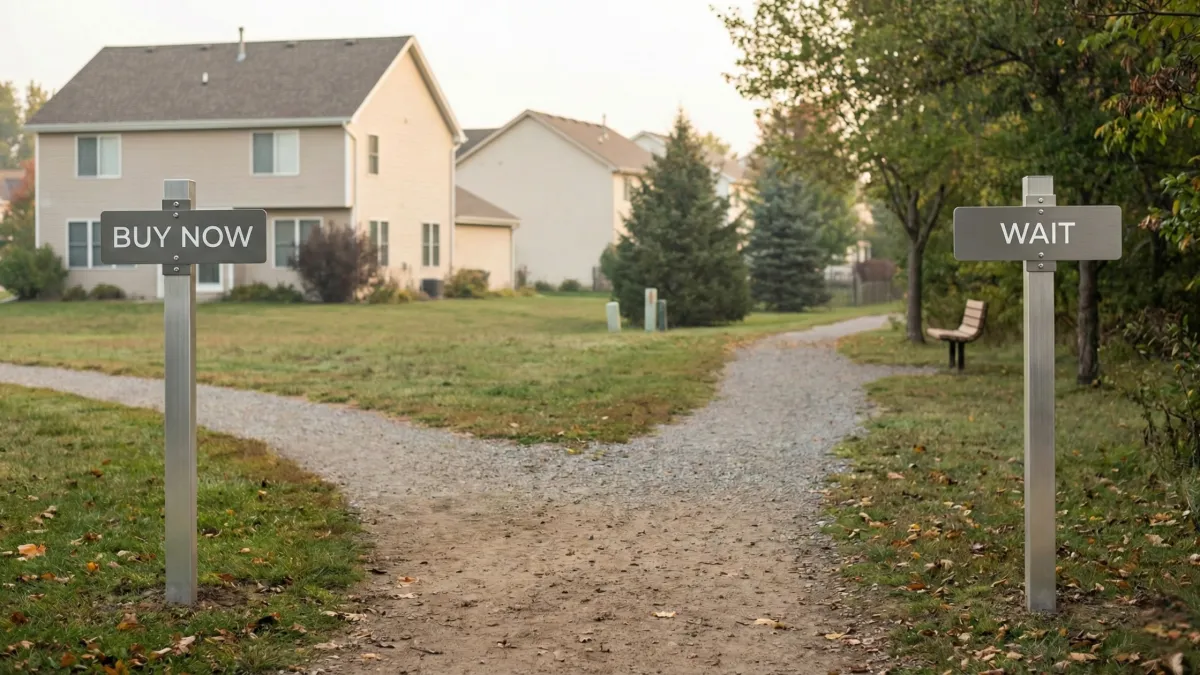
Should I Wait for Mortgage Rates to Drop Before Buying a Home?
If you're asking this question, you're not alone—and you're not behind.
Most first-time buyers spend months (sometimes years) stuck in this loop. They watch rates. They check home prices. They read articles that contradict each other. They wait for certainty that never comes.
Here's the truth: the market will never give you a clear green light. But your personal financial situation can.
The right question isn't "Is the market ready?" It's "Am I ready?"
This guide reframes the buy vs. wait decision around what you can actually control—and helps you get off the fence with clarity instead of guessing.
Why First-Time Buyers Get Stuck
The buy vs. wait question feels paralyzing for a reason.
Buying a home is one of the largest financial decisions you'll ever make. And it feels irreversible. So your brain does exactly what it's designed to do: it looks for certainty before it lets you act.
The problem: certainty doesn't exist in real estate.
Rates fluctuate. Prices move. Markets shift by neighborhood, by month, by economic event. Anyone who tells you they know exactly where the housing market is headed is guessing—even the experts.
Home values have climbed significantly over the past five years, and experts suggest the situation may not improve dramatically in 2026—meaning waiting is no guarantee of a better deal. (Source: U.S. News Real Estate, June 2025)
What first-time buyers actually need isn't a market prediction. It's a personal readiness framework that removes surprises regardless of what the market does.
The Market Reality in 2026 (Without the Hype)
Before we get to your personal decision, here's a grounded look at where things stand.
Mortgage rates: As of early 2026, the average 30-year fixed mortgage rate sits around 6.16%, near its lowest levels in years. Redfin projects rates will average approximately 6.3% for 2026, with brief dips possible but dramatic drops unlikely. (Source: Redfin, February 2026)
Home prices: According to the National Association of Realtors, home prices are projected to increase around 4% nationally in 2026. A shortage of available homes is expected to continue, keeping prices from falling significantly. (Source: NAR via Rocket Mortgage, 2025)
Inventory: Housing inventory has risen from its post-pandemic low, giving buyers more negotiating power in many markets—particularly in the South. However, supply remains limited in parts of the Midwest and East Coast. (Source: Redfin, February 2026)
What this means for you: Waiting for rates to fall dramatically or prices to drop significantly is a high-risk strategy. Markets are moving slowly, not crashing. Every month you wait is a month of potential equity growth you don't capture—and a month of rent that builds someone else's wealth.
That said—waiting is sometimes the right call. More on that below.
The 5 Questions That Actually Answer "Buy Now or Wait?"
Forget the market forecasts for a moment. These five questions will tell you more about your readiness than any economist can.
1. Is Your Financial Foundation Stable?
Buying a home when your finances are shaky doesn't make you a homeowner—it makes you stressed.
Ask yourself:
• Is your income stable and verifiable (at least 2 years of employment history)?
• Do you have a down payment saved—plus closing costs—plus an emergency fund after closing?
• Is your credit score 620 or above?
• Is your debt-to-income ratio below 45%?
If the answer to all four is yes, your financial foundation supports buying now.
If one or more is a "not yet," you have a clear roadmap for what to work on—and a timeline for when you'll be ready.
The guardrail: Buying before your foundation is solid leads to regret. Buying after it's solid leads to confidence.
2. Can Your Monthly Payment Pass the Sleep Test?
This is the question most buyers skip—and the one that matters most.
It's not "Do I qualify for this payment?" It's "Does this payment let me sleep at night?"
Lenders approve you based on your maximum qualifying payment. That's their ceiling. Your comfort zone is your floor—and only you know where that is.
A payment that's technically affordable but emotionally unsafe leads to three outcomes: financial strain, resentment toward the home, and regret.
Before you decide to buy now vs. wait, get a real payment estimate from a mortgage broker at Dwell Mortgage. Not a rough number—a full payment including principal, interest, taxes, insurance, and PMI if applicable.
If that payment feels safe with room to breathe, you're ready. If it feels tight even before any surprises, wait until your income increases or your down payment grows.
The guardrail: Affordability is not a number. It's how safe you feel paying it every month.
3. Are You Planning to Stay for at Least 3-5 Years?
Buying a home comes with significant upfront costs—closing costs, moving expenses, potential repairs. It typically takes 3-5 years for appreciation and equity growth to outweigh those costs.
If you're likely to move within 2 years—job uncertainty, relationship changes, life transitions—renting gives you flexibility that homeownership can't.
If you can see yourself rooted in the same area for the next 5+ years, every month you own instead of rent is a month you build equity rather than someone else's.
The guardrail: Buying is a 3-5 year minimum commitment to make the math work. If your life isn't ready for that, waiting is the right financial decision—not a failure.
4. What Is Waiting Actually Costing You?
This is where most first-time buyers underestimate the math.
Waiting feels safe. But waiting has a real cost.
The rent cost: Current national average rents are around $1,631 for a one-bedroom and $1,887 for a two-bedroom apartment—with increases expected to continue in 2026. (Source: Apartment List / Yahoo Finance, December 2025) Every month you rent is a month of housing cost with zero equity return.
The price appreciation cost: If home prices grow 4% annually on a $350,000 home, that's $14,000 in value added per year—value that goes to current owners, not future buyers.
The rate gamble cost: Waiting for rates to drop significantly is a bet that doesn't always pay off. Redfin's Head of Economics Research notes that rates have been trading in a narrow range and dramatic drops are unlikely in the near term. If rates do drop, more buyers enter the market—pushing prices up and potentially eliminating any savings.
What waiting buys you: Time to improve your credit, save more, or achieve financial stability. Those are legitimate, valuable reasons to wait. The market dropping to make buying easier? That's not a reliable plan.
The guardrail: Waiting is a financial decision, not a neutral one. Know what you're gaining and what you're giving up.
5. Do You Have Guardrails in Place?
First-time buyers who buy successfully don't have perfect timing. They have a plan that limits downside.
Your guardrails checklist:
• Payment you can cover even if life gets expensive for 2-3 months
• Emergency fund that stays intact after closing (3-6 months of expenses)
• Clear understanding of total housing costs (not just the mortgage)
• Stable employment with no major changes planned
• Home purchase price 10-20% below your maximum pre-approved amount
If your guardrails are in place, you can buy confidently in any market—because your plan absorbs surprises instead of being derailed by them.
The guardrail: If your guardrails aren't in place yet, waiting to build them isn't weakness. It's wisdom.
Honest Reasons to Buy Now
If your finances are ready, here's what buying now gets you:
Equity starts immediately. Every mortgage payment builds ownership. Every month you rent builds your landlord's equity instead.
Fixed payment, known cost. A fixed-rate mortgage locks your payment for 30 years. Rent increases every year—and you have no control over it.
Rates are manageable—and refinanceable. Current rates around 6% aren't historically extreme. And if rates drop significantly, you can refinance. You can't go back and buy at today's prices if you wait and they rise.
More negotiating power now. Inventory has risen and buyer demand remains softer in many markets, giving today's buyers more leverage for concessions, seller credits, and price reductions than they've had in years. (Source: Redfin, February 2026)
Programs that help. Down payment assistance programs, state housing finance programs, and FHA/VA/USDA loans make buying more accessible than many first-time buyers realize. Waiting doesn't increase your access to these—acting does.
Honest Reasons to Wait
Waiting is the right call if:
• Your emergency fund would disappear at closing (too financially exposed)
• Your credit score is below 620 (6 months of focused improvement can save thousands)
• Your DTI is above 45% (buying now stretches you to the breaking point)
• You're likely to move within 2 years (buying and selling quickly kills the math)
• Your income is unstable or in transition (lenders need consistency; so does your peace of mind)
• The payment makes you anxious even before looking at the home (emotional readiness matters)
None of these mean you can't buy. They mean you're not ready yet—and that's useful information. Now you have a clear plan for what to fix and when you'll be ready.
The "Wait for Rates to Drop" Trap
This deserves its own section because it's the most common waiting mistake.
Here's what buyers believe: "If I wait for rates to drop from 6.5% to 5.5%, I'll save significantly."
Here's what actually happens: When rates drop, more buyers enter the market. Demand spikes. Prices rise. The savings from the lower rate often get absorbed—or exceeded—by higher purchase prices.
You also lose months or years of equity growth, continue paying rent with no return, and take on the risk that rates don't drop as expected.
The smarter approach: buy when you're financially ready at today's prices and rates. If rates drop later, refinance. You keep the equity you've built and capture the lower rate.
You can always refinance a rate. You can't go back and buy at a lower price.
The Only Real Answer to "Buy Now or Wait?"
It depends on your situation—not the market.
A mortgage broker at Dwell Mortgage can run the actual numbers for your income, credit, down payment, and target price range. They'll show you:
• Exactly what you qualify for today
• What your real monthly payment looks like (not a rough estimate—the actual number)
• Whether your financial picture supports buying now or what to improve first
• Which programs or assistance you might qualify for that change the math
At Dwell Mortgage, pre-approval uses a soft credit pull—meaning you get real answers with zero impact to your credit score. If you're ready, you'll know. If you need more time, you'll have a clear roadmap.
The buy vs. wait question stops feeling impossible the moment you have real numbers in front of you.
Stop Waiting for Certainty. Start Building Guardrails.
Nobody buys with perfect timing. Smart buyers buy with a plan that limits downside.
If your finances are stable, your payment passes the sleep test, and you're planning to stay put for 5+ years—you're probably ready. The market will never be perfect. Your preparation can be.
If you're not ready yet—that's not failure. That's clarity. Now you know exactly what to work on.
